Nodal Discernment
The sixth principle in our series about the application of the 7 First Principles of Regeneration from Carol Sanford.
In traditional Chinese medicine, acupuncturists don't treat a headache by pressing on your forehead. Instead, they might place needles in your foot, your hand, behind your knee—multiple points, carefully selected based on reading your body's unique state, in that moment. The specific constellation of points matters. Miss one, or place them at the wrong time in your body's cycle, and the intervention fails. Get it right, and the headache dissolves along with the deeper imbalance causing it.

This is how we've learned to think about intervention in complex systems.

Consider LEED, the green building rating system. It emerged at a precise moment: the building industry was booming, developers wanted marketing differentiation, and "green building" lacked clear definition or had become meaningless through greenwashing. LEED didn't invent sustainable building—those practices existed. It tapped into multiple nascent demands simultaneously: accountability, peer comparison, clarification of market confusion, market advantage, professional credibility, emerging technical developments. The system exploded precisely because it hit several pressure points at once, in an industry primed for change.
But here's what's interesting: LEED worked then. Try to replicate that same intervention now, and it barely moves the needle. The system evolved. LEED became the establishment, created its own incrementalism, its own status quo. The nodes have moved. New forms of intervention are needed, but there's a gravitational pull to just "do LEED harder"—more points, more credits, stricter compliance requirements. The original transformational insight appears to have calcified into exactly the kind of mechanical thinking it once disrupted.
This is what we call nodal discernment—the capacity to identify where and when to intervene in living systems for disproportionate impact. Among the 7 First Principles of Regeneration that guide our work, this one is perhaps the most difficult to explain, and maybe that's fitting. The others—potential, essence, development—can sound familiar enough that you think you understand them (which can be its own trap). But nodal thinking? It contradicts almost everything Western modern culture teaches us about how change works. It requires a paradigm shift.
Why This Is Hard to See
We're taught to "take it one step at a time." To "not bite off more than you can chew." To Keep It Simple. This mentality—call it incrementalism, gradualism, reductionism—is so pervasive in Western culture that it feels like common sense. Older professionals offer it to younger ones as hard-won wisdom: "This is how it really works, kid."
But watch what happens when we apply this thinking to complex living systems: We identify a problem. We develop a solution. We implement it. The problem persists, or shifts, or spawns three new problems. So we double down: more programs, more compliance, stricter standards, bigger budgets. The mentality becomes "if it's not working, do it harder."
This isn't just ineffective—it's hypnotic. Martin Luther King Jr., in his "I Have a Dream" speech, warned against what he called "the tranquilizing drug of gradualism." Not only because of its expectation of slowness, but because it tricks us into believing we can add up fragmented progress over time and eventually reach systemic change. By fixating on incremental steps, we're lulled into missing the compounding benefits that emerge when multiple dimensions of complex living systems evolve in relationship with each other.
The illusion misses that complexity exists. We tend to project simplicity onto living systems and expect it to stick. We fragment reality into manageable pieces (call them "silos," "sectors," "issue areas"), apply isolated solutions, and wonder why nothing fundamentally shifts. Economics gets severed from ecology, building design from community health, energy systems from social equity. We optimize each piece independently and are baffled when the whole keeps deteriorating.
This approach works, somewhat, when building machines. It fails catastrophically with living systems. And yet it's the water we swim in—the default operating system loaded into every professional training, every org chart, every grant application, every regulatory framework.
Nodal thinking requires something completely different: the capacity to read where a living system is primed for transformation, to discern which interventions will cascade and which will be absorbed, to act with precision and timing rather than force and repetition. It asks us to see the system as it actually is and how it works—evolving, interconnected, responsive—not as we wish it were: static, linear, controllable.
What Nodal Work Actually Is
Nodal discernment is the capacity to identify specific junctures—both spatial and temporal—where strategic intervention creates disproportionate, cascading change in a living system. These are the most potent actuators, but with a crucial addition: they're not permanent features of a system's architecture. They emerge, intensify, and dissolve as the system evolves.
Donella Meadows gave us invaluable language about places to intervene in systems—from adjusting parameters/numbers (least effective) to shifting paradigms (most powerful). Her framework taught us that not all interventions are created equal, that some places in a system's structure offer far more influence than others. Nodal thinking embraces her most powerful levers—particularly those that address system structure and paradigm—but adds what her somewhat mechanical framing couldn't fully account for: some systems are alive.
Living systems respond to interventions that don't appear within a mechanical leverage typology at all: Creating containers for emergence. Timing cultural inflection points. Choreographing disruptions. Reframing narratives. Activating dormant networks. Redirecting an attacker's momentum from threat into harmless stumble, aikido-style. These are nodal interventions. They work with the evolving nature of living systems, whereas treating such systems as machines to be re-engineered does not.
This is why Bill Reed, a colleague and pioneer in regenerative practice, observes that nodal work is "the only one of the seven First Principles that's not constantly available." Potential is always present. Essence doesn't disappear. But nodes flicker in and out of accessibility—sometimes in fleeting moments, sometimes in perennial cycles, sometimes stationed in particular places where the system's structure makes it persistently vulnerable to systemic transformation.
We can miss a node in three ways:
Location–intervening in the wrong part of the system to have the intended effects
Education Reform: Pouring resources into standardized testing and curriculum changes (the classroom level) when the actual node is teacher burnout and retention (the profession's economic structure and working conditions). You're intervening downstream when the leverage is upstream.
Urban Blight: Focusing solely on building renovations and facade improvements in a declining neighborhood when the node is actually the lack of local ownership and wealth circulation. The physical decay is a symptom; the economic extraction is the cause. Intervening on aesthetics when you need to intervene on ownership patterns.
Organizational Dysfunction: Implementing new software/processes to improve team collaboration when the actual node is the leadership's command-and-control mindset that makes genuine collaboration impossible. You're tweaking the tools when you need to shift the paradigm.
Timing–acting too early (the system isn't ready), too late (the opening closed), too frequently (too many disruptions to avoid instead collapsing the system), or too infrequently (not introducing enough interventions in right-timing),
Too Early: Proposing renewable energy infrastructure in 1970's when oil was cheap and climate wasn't yet in public consciousness. The technology existed, but the cultural/economic system wasn't primed. Money and political capital wasted on something that would be embraced 30 years later. (Note, we need pioneers like this, or we wouldn't have anything to scale-up now that the system is more ready.)
Too Late: Trying to save a dying mall with minor upgrades in 2020 after e-commerce has fundamentally restructured retail. The window for adaptive reuse was 2010-2015; by 2020 the system had already reorganized around the mall's absence.
Too Frequently: Constantly reorganizing a company's structure every 18 months. Each reorg creates disruption, and before people can adapt and the new structure can prove itself, another one hits. The system never stabilizes enough to actually evolve; it just stays in perpetual trauma response.
Too Infrequently: A regenerative farm that only introduces new practices every 5-10 years, missing the annual cycles where soil biology, crop rotations, and market conditions create natural openings for innovation. The system is ready to evolve faster than the farmer is intervening.
Typology–misreading the nature of the node, the system's current state, or the form of intervention it can receive in service of positive transformation
Community Organizing: A wealthy foundation arrives in a low-income neighborhood with a fully-designed community center plan, when what the community actually needs is capacity-building and decision-making power. The typology mismatch: they offered infrastructure when the node was agency/empowerment.
Ecological Restoration: Bringing in heavy machinery to "restore" a degraded wetland by reshaping topography, when the system actually needed gentle removal of invasive species and protection from further disturbance to allow natural succession. The intervention type (aggressive physical restructuring) didn't match what a fragile ecosystem could receive.
Addiction Recovery: Offering someone in active addiction a job training program when they need trauma therapy first. The typology is wrong—skills development can't be received by a nervous system in survival mode. Sequence matters; you can't skip developmental stages.
Extremity/Intensity–even getting all others well discerned, sometimes pushing too hard, or not hard enough can make a difference in whether the change is initiated
Too Hard: Implementing a complete whole-building energy retrofit all at once on a historic structure, creating so much disruption that tenant displacement occurs, community resistance builds, and the project becomes a cautionary tale rather than a model. The right moves, but the intensity broke the social fabric that needed to support the change.
Too Hard (ecological): Introducing prescribed fire to a forest ecosystem that hasn't burned in 100 years at the same intensity as historical fires. The system has changed—fuel loads are massive, native species may be too weak—and a "correct" historical intervention at full intensity could destroy rather than regenerate.
Not Hard Enough: A company implements "sustainability initiatives" that are purely voluntary and have no accountability mechanisms, resource allocation, or leadership attention. It's greenwashing masquerading as change—the intervention is so weak it gets absorbed without moving anything.
Not Hard Enough (policy): Carbon pricing set so low that it doesn't actually shift behavior or investment patterns. The intervention type is right (economic signal), the timing might be right (climate crisis urgent), but the intensity is calibrated to political palatability rather than system transformation needs.
The Greensboro lunch counter sit-ins of 1960 in North Carolina offer a glimpse of this pattern. Four Black college students sitting peacefully at a Woolworth's counter created an irresolvable contradiction for business owners: serve them and violate segregation norms, or refuse and reveal the absurdity of those norms on camera. The tactic spread virally precisely because it was both replicable and context-dependent—you couldn't just "do sit-ins" anywhere, anytime. The multiple needles: nonviolent presence (moral high ground), commercial space (economic pressure), media coverage (national exposure), college students (sympathetic protagonists), momentum from Montgomery bus boycott (network primed), precise moment in cultural shift (post-Brown v. Board but pre-Civil Rights Act). Remove any one element, and the intervention loses potency.
And here's the critical piece, returning to our acupuncture metaphor: it's almost always multiple needles. Not a single silver bullet, but a constellation of simultaneous interventions that work in concert. Remove one needle from the pattern, and the treatment fails. This is why so many well-intentioned efforts falter—they identify a leverage point but miss that several interrelated conditions must be activated together for transformation to occur.
Consider again LEED's emergence: It wasn't just "create a rating system." It was:
A certification structure (accountability)
A point system (gamification/competition)
Comprehensible (using extant industry standards as performance benchmarks)
Clarification of market confusion (defining green buildings across five categories)
Market recognition (economic incentive)
Peer comparison (professional credibility)
Accessible entry point (you could start small)
Timing (industry boom + greenwashing backlash)
Miss any one of those, and LEED doesn't take off. The multiple needles created a pattern that the system could receive. But as the system evolved—as LEED became establishment rather than disruptor—that same pattern stopped working so well. The nodes moved. Hence, new interventions are needed, while the gravitational pull of a mechanical paradigm repeats what worked before, just louder.
This is the trap: We find something that works and we standardize it. We turn nodal intervention into protocol. We scale it. We train people to apply it regardless of context. We measure compliance. We quantify results as static. And we're shocked when what initially worked stops transforming anything.
What This Requires of Us
Nodal discernment isn't a technique you can learn in a workshop. It's a developed capacity that requires fundamental shifts in how we perceive and engage with systems.
First, it demands deep systemic literacy. We have to be able to read a system—not just its visible structures and problems, but its patterns of relationships, its current developmental state, its trajectory, what's dormant and what's activated. This is diagnostic work, akin to an acupuncturist reading your pulse, observing your tongue, observing somatic states, asking seemingly unrelated questions to understand your body's unique expression of imbalance. You can't intervene nodally if you can't perceive the system's actual current condition.
Second, it requires what we call external considering—the capacity to set aside one's own agenda, preferences, and preconceptions long enough to perceive what the system actually needs and what it's trying to become. This is harder than it sounds. We bring our solutions with us. We see the problems we're trained to see. We intervene in ways that make us feel effective. External considering asks: What does this particular system, in its current state, have the capacity to receive? What's wanting to emerge here that our intervention could midwife?
Third, paradoxically, it asks for both patience and readiness. You can't force a node into existence through will or urgency. The system has to be primed, favorable conditions have to emerge and align, the moment has to arrive. But when it does, hesitation may allow the opening to close. This requires a particular kind of consciousness—being attentive, responsive, comfortable holding potential energy until the moment calls for kinetic release.
Consider how photographic evidence of violence functioned as nodal intervention in the 1960s and 70s. Images from Selma—state troopers beating peaceful marchers on the Edmund Pettus Bridge—shocked the national conscience and accelerated the Voting Rights Act. Vietnam War photography—the burning monk, the naked girl fleeing napalm, the execution on a Saigon street, massacred children in My Lai—turned public opinion against the war in ways that body counts and policy debates couldn't. But here's the key: that same intervention doesn't work now. We're saturated with images of violence. Atrocity footage circulates daily on social media and generates shrugs, arguments about context, or brief outrage that dissipates by the next news cycle. The system evolved immunity. What was once a potent node—exposing hidden violence to create moral crisis—has calcified into white noise. The photographers found the node; we're still trying to press it decades later, wondering why nothing moves.
Fourth, it requires comfort with uncertainty and partial knowledge. Nodes aren't always visible through analysis alone. Sometimes we sense them—a felt sense that here, now, this is the place to push. Sometimes we see them only in retrospect, recognizing that a seemingly minor intervention cascaded in ways we couldn't have fully predicted. This isn't mysticism; it's acknowledging that living systems are fundamentally more complex than our models of them. Intuition—informed intuition, sourced from deep systemic understanding and based upon sympathetic understanding of experience—is not optional.
And finally, perhaps most difficult: nodal work requires willingness to let go of what worked before. Years ago, I worked with a group organizing against a proposed LNG pipeline. An older activist—someone who'd been in the streets during the transformative movements of the 1960s—recoiled when I suggested we split into "fight-against" and "fight-for" subgroups, with the latter publicly unaffiliated with the opposition. "We must all stand unified against the powers that be," she insisted. When I pressed why she opposed the strategy, she said, "I've been around long enough to see it work." My response: "But that's the problem—it doesn't anymore. You have to be old enough to remember when it did." Picketers don't get invited into the boardroom now; they're too easy to ignore. The system evolved. She's not wrong that those tactics once transformed culture. She's trapped by that memory, unable to see that the nodes have moved. This is the seduction of success: we want to believe we've found "the answer," that we can systematize it, repeat it, teach it to others as protocol. Nodal thinking demands we stay supple, curious, responsive to what this system at this moment is ready to receive.
One more element matters tremendously: what we call place-sourcing, or more playfully, place-sourcery. This is the practice of sourcing intervention strategies from the unique essence of the place or system itself, rather than importing generic solutions. Every place is a living entity with its own crystalline nature—its own essence that persists regardless of current state. Take East Boston: it has always been a threshold. Where water meets land. Where immigrants arrived to begin American lives. Where planes depart into the world beyond the Atlantic. And the essence of how this "thresholding" works in Boston is distinctly different from other similar threshold places on the East Coast, such as New York or Philadelphia. That essence doesn't disappear when the waterfront degrades or the community gentrifies—it's still expressing itself, still trying to work through whatever conditions currently exist. Understanding even partially who a place is and how life is trying to work there makes nodes dramatically more visible. You stop asking "what works for waterfront redevelopment generally?" and start asking "what intervention would help this particular threshold place reconnect to its own life-force?"
This is slow work that enables fast transformation. It's the opposite of our cultural conditioning: grab a solution, implement it everywhere, measure compliance, scale. Nodal work asks us to slow down enough to read the living system in front of us, to develop a relationship with it, to perceive where it's primed for change, to intervene with precision and timing rather than force and repetition.
Or consider Thomas Paine's Common Sense, published in January 1776. On its surface, just a pamphlet—46 pages arguing for independence. But the timing was exquisite: after Lexington and Concord made violence real but before the Continental Congress committed to full separation. The intervention worked on multiple levels simultaneously: accessible language that reached beyond colonial elites, framing independence as common sense rather than radical (neutralizing fence-sitters), published when latent sentiment was ready to crystallize but hadn't yet found its voice. It sold 500,000 copies in a population of 2.5 million—roughly equivalent to selling 65 million copies in today's America. Five years earlier, it would have seemed treasonous fantasy. A year later, it would have been redundant. Paine found the node—not through force of argument alone, but through precise attunement to when and how the colonial system was ready to reorganize itself around a new possibility.
Nodal Work in Practice
This might all sound abstract—elegant in theory, elusive in application. So let's ground it in actual work.
Pennsylvania DEP Cambria Office Building: A Nodal Moment in Design
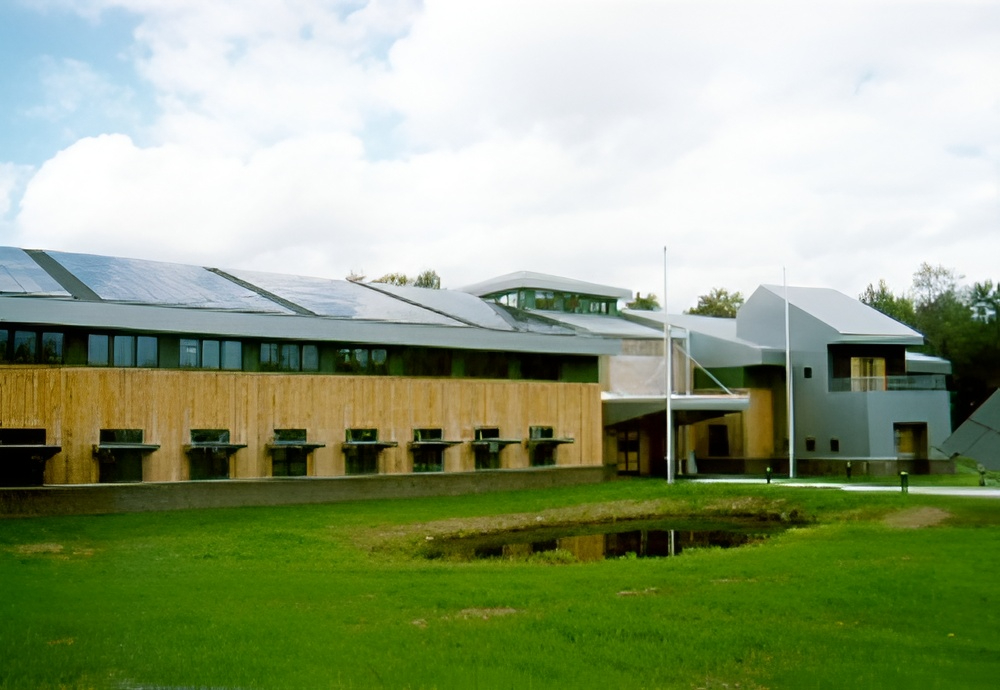
On our second project for the Pennsylvania Department of Environmental Protection, we made a conscious decision to employ an integrative design process. Twenty minutes into an early schematic design meeting, the team was deep in conversation about how to route piping from ground-source heat pumps up to a penthouse mechanical room on the roof, then distribute ductwork back down to underfloor air plenums on both floors. The discussion felt productive—everyone collaborating on how to fit vertical shafts into the core, avoid conflicts with elevators and structure, coordinate sprinkler pipes.
Then the architect (7group partner John Boecker) stopped the meeting. He realized this wasn't integration—it was just accelerated coordination. More critically, he'd already decided to put the HVAC equipment in a rooftop penthouse without consulting anyone. He'd made that choice alone, from habit.
He turned to the mechanical engineer, John Manning: "If you were designing this building, where would you locate the central HVAC components? Where's the best place for the mechanical room?"
Manning sat stunned. After twenty years designing HVAC systems, no architect had ever asked him that question. He said later he felt like a deer in headlights.
Within minutes, Manning proposed something entirely different: place the eleven heat pump units in two ground-floor mechanical rooms—one serving each wing. This eliminated all piping to the roof and back. Supply air could reach the first-floor plenum with just a foot or two of ductwork; the second floor needed only five feet of vertical runs instead of routing everything from the penthouse. Shorter duct and pipe runs meant less resistance, smaller fans and pumps, lower energy use, not to mention saving the material itself and its lifecycle impacts. And maintenance staff could access equipment in weather-protected ground-floor spaces instead of climbing through a janitor's closet onto the roof in snow and rain.
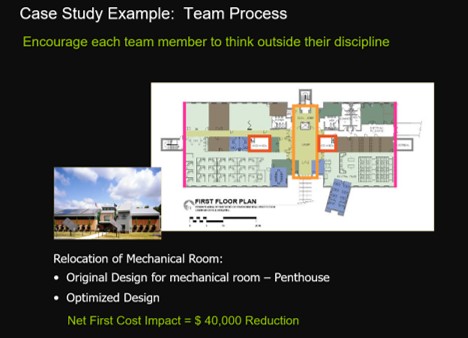
The solution was elegant. Everyone loved it except the developer, who heard only that he'd lose 400 square feet of prime lease space. But the new design saved $40,000 in construction costs—enough to add inexpensive length to each wing's end, recovering the lost square footage while capturing significant operational savings from energy efficiency and simplified maintenance.
This is what nodal work looks like in practice. The intervention wasn't heroic—just one question at the right moment. But multiple conditions had to be present simultaneously for it to work:
- Early timing in the design process, when fundamental decisions were still fluid
- Non-territorial team culture where the architect could question his own assumption and genuinely invite input
- Expertise available in the room (Manning's twenty years of experience)
- Real-time collaborative space where the new idea could be heard, evaluated and adopted immediately
- Economic literacy on the team to quickly calculate construction cost savings
- Openness to questioning "how we've always done it"
Remove any one of those needles, and the pattern fails. The mechanical room stays on the roof, $40,000 gets spent on unnecessary piping and ductwork, maintenance staff climb ladders in the snow for thirty years, and no one ever knows what was possible. The node was there—twenty minutes into a schematic design meeting—but only visible because the team had created conditions where fundamental assumptions could be questioned and expertise could flow across disciplinary boundaries.
This is what nodal work looks like in the built environment: not heroic single moves, but constellations of conditions creating openings for system-level transformation. The needles had to be placed simultaneously—miss one, and the pattern fails.
Questions for Discernment
If you're wondering how to begin developing this capacity in your own work, here are some of the questions we use to resource our thinking—to sharpen our ability to read systems and perceive nodal opportunities:
For Built Environment Projects:
What is this place trying to be? What essence is expressing itself here, regardless of current condition?
Where in the design/construction process is the team most open to fundamental rethinking (paradigm shifting)? (Not "what can we optimize?" but "where could we intervene to unlock entirely different possibilities?")
What combination of conditions—technical, relational, timing, market forces—would need to align for breakthrough to be possible here?
If we could only intervene in three places in this project, which would create the most cascading benefit?
What's trying to emerge in this project that the conventional process is suppressing?
Is this system primed for transformation, or are we forcing intervention before it's ready?
For Organizations and Teams:
Where is this organization experiencing productive tension—not crisis, but the discomfort that precedes growth? What's the difference between what this organization *says* it values and how it actually allocates attention and resources? (That gap is often where nodes live.)
Who in this organization is already sensing that change is needed, even if they don't have language for it? (They're often your allies in nodal intervention.)
What would become possible if we intervened in how this team makes decisions, rather than just *what* they decide?
Is this the right moment to push, or are we trying to force a node into existence?
What did this organization's "LEED moment" look like—what once worked brilliantly that's now calcified into protocol?
For Community Development Work:
What does this community already know about itself that outsiders keep missing? Where is there latent capacity—networks, skills, desires—that lack only a catalyst to activate?
What's the difference between what the community needs and what funding structures reward? (Nodes often live in that gap.)
Who are the connectors—not necessarily the loudest voices or official leaders, but the people who link different parts of the community?
What intervention would help this community reconnect to its own life-force, rather than making it dependent on external resources?
Is this a moment for action, or for creating conditions where action will become possible later?
Questions That Cut Across All Contexts:
- If we could only place three acupuncture needles in this system, where would they go?
- What's the smallest intervention that could catalyze the largest shift?
- Are we reading the system as it actually is, or as we wish it were?
- What worked last time that we're reflexively trying to repeat—and has the system evolved past that intervention? What are the primary restraining forces that currently appear to be working against system transformation?
- What are we avoiding because it seems too difficult, too political, too costly—that might actually be where the node lives?
- Who benefits from keeping this system stuck? (Sometimes the resistance reveals the node.)
- What wants to emerge here that our intervention could midwife?
Closing Thoughts
Nodal discernment is difficult to grasp because it contradicts almost everything our culture teaches about change: that it's linear, mechanical, controllable and scalable. It asks instead that we treat systems as alive—evolving, contextual, responsive. It requires us to develop capacities our professional training typically neglects: the ability to read essence, to seek emergence, to perceive timing, to hold multiple interventions in constellation, to act with sensitive precision rather than force.
But here's what makes it worth the difficulty: it actually works. Not in the way we're conditioned to measure success—not through compliance metrics or incremental improvements—but through the disproportionate, cascading transformation that emerges when you touch a living system at the right places, at the right time, in the right way.
The nodes are there. They're always there, flickering in and out of availability as systems evolve. The question is whether we're developing our capacity to see them.
This article continues an eight-part series aimed at exploring how regenerative practices can be used to build our capacity to engage with larger living systems. In particular, we've examine how built environment projects can serve as powerful and effective instruments for doing so. These practices are grounded in the 7 First Principles of Regeneration. These principles emerged through the work of Carol Sanford, a wise and insightful elder, and through our work with Carol, Bill Reed, Joel Glanzberg and others over the past decade. Inspired by this continuing work, we have unpacked these seven principles through the context of our experiences co-creating habitation. The principles include: